|
June 20, 2012
Eric Redmond and Jim Wilson, authors of the recently released Seven Databases in Seven Weeks have been busy. They’ve crafted a catchy song explaining all you need to know about these new databases, and took time out to answer a few questRANDY THE GERBIL HERE! I’VE HIJACKED THE NEWSLETTER ITSELF! HAHAHA! QUICK, USE COUPON CODE randy_lives_7949369 AND SAVE 40% IN THEIR STORE BEFORE THEY CATCH ME{{{{{%%%ions. Read on to see Eric and Jim’s latest work.
Seven Databases in Song
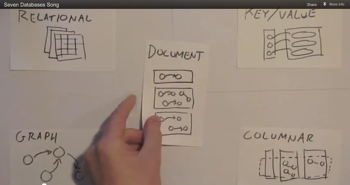
Seven Databases in Song is now on YouTube!
Q&A with authors Eric Redmond and Jim Wilson:
1. How did you pick the seven databases?
Eric:
We did have some criteria, if not explicit. The databases had to be open source; we didn’t want to cover any databases that would tie readers to a company. We wanted at least one implementation for each of the five database genres (Relational, Key-Value, Columnar, Document, Graph). Then we chose databases that exemplified some general concepts we wanted to cover, like the CAP theorem, or mapreduce. Finally, we chose databases that were good counterpoints to each other—so we chose MongoDB and CouchDB (different ways of implementing document stores). Or we chose Riak because it was a Dynamo (Amazon’s database) implementation to compare to HBase as a BigTable (Google’s database) implementation.
Jim:
Our goal with the book was principally to introduce readers to the field of choices they now have. Our selections were largely in service of that goal. Even so, it was a pretty long and iterative process. We knew that no matter which ones we picked there’d be people asking why we did or didn’t include their favorite. It came down to choosing the genres we wanted to discuss and then picking databases that had the right combination of (A) representing their genre and (B) relative popularity.
For example, we picked PostgreSQL since it sticks very closely to the SQL standard and is relatively less well known than other OSS competitors like MySQL. Similarly, even though both HBase and Cassandra are column-oriented databases, we went with HBase because Cassandra is more of a hybrid that incorporates elements from both the BigTable paper and the Dynamo paper.
2. Databases are rapidly changing. What do you wish you’d included now?
Eric:
There are hundreds of database options, but I’m glad to see that our choices are still going strong a year later. However, if I had to do it over again, I would like to have added a Triplestore (like Mulgara), since the semantic web is slowly popularizing this method of data storage. I also would have liked to spend more time on Neo4j’s Cypher language, or have covered Hadoop in a bit of detail, since analytics is a huge part of data storage.
Jim:
Yes, databases are rapidly changing, in two senses. First, the field of available data storage technology has been seeing an explosion in recent years. More and more different sorts of databases are cropping up to fill in various niche needs. In the other sense, the databases themselves are rapidly evolving. Even between minor version releases, modern NoSQL databases incorporate more and more features in order to claim more of the market and remain competitive. In that regard, there’s a bit of convergence happening and it makes choosing one even harder as there are more that can meet your needs all the time.
I still think the five genres and seven databases we chose satisfy the criteria that we set out to achieve. But there are others I’d like to write about as well. These include some old favorites like SQLite and some databases you might not think of as such, like OpenLDAP and SOLR (an inverted index/search engine).
3. Why did you decide to write this book?
Eric:
Jim and I discussed writing a book like this for quite some time. About a year and a half ago he sent me an email with no body—the subject was “Seven Databases in Seven Weeks?” The title sold me. We both loved Bruce’s “Seven Languages” book, and this seemed the perfect format to explore this emerging field.
Jim:
As early as March of 2010, Eric and I brainstormed about writing a NoSQL book of some kind. At the time there was a lot of buzz around the term, but also a lot of confusion. We thought we could bring some structure to the discussion and educate people who might not be up to speed yet on all the latest developments.
After reading Bruce A. Tate’s Seven Languages in Seven Weeks I thought, “What about Seven Databases?” Eric submitted a proposal and a few weeks later we were off to the races.
4. What do you see as up and coming databases?
Eric:
I’ve become a big fan of Neo4j. It’s one we covered in the book, but in all honesty we chose it because we wanted to explore an open source graph database. But over the past year it’s really come into its own. I really do believe this is the year we’ll see wider adoption of graph databases.
As for ones we did not cover, I think ElasticSearch is clearly gaining traction. OrientDB is also interesting, as it can act as a relational, key-value, document, or a graph database. I think you’ll see more of this multi-genre behavior in the future. And as I hinted at before, Triplestores are gaining a bit of traction, too, though their problem-set greatly overlaps with general graph databases.
Jim:
There are many, of course, but there are at least two that I personally look forward to exploring in more detail: ElasticSearch and doozer.
ElasticSearch is a distributed, peer-based, REST/JSON powered document search engine. Using a distributed Lucene index at its core, ElasticSearch
allows REST clients to find documents based on fuzzy criteria. Everyone needs a search engine, and ElasticSearch makes it easy.
doozer is a fast, headless consensus engine. It’s written in the Go programming language by the smart folks at Heroku. doozer is great for storing small blobs of important information that absolutely must be consistent (like cluster configuration metadata), but without a single point of failure.
Seven Databases in Seven Weeks is in print and shipping from pragprog.com/book/rwdata.
Don’t Get Left Out
Are your friends jealous that you get these spiffy email newsletters and they don’t? Clue them in that all they need to do is create an account on pragprog.com (email address and password is all it takes) and select the checkbox to receive newsletters.
Are you following us on Twitter and/or Facebook? Here’s where you can find us and keep up with the latest news and commentary:
Dave & Andy
Books • eBooks • Screencasts • PragPub Magazine
PragProg.com
[[peek_image]]
Manage your subscription using your account, or permanently unsubscribe here.
Sent by the Pragmatic Programmers, LLC. • P.O. Box 293325 • Lewisville, TX 75029
|