|
October 07, 2015
Today is a great day! Except when it doesn't exist. Because of the implementation of the Gregorian calendar, there is no October 7, 1582 in Italy, Poland, Portugal, and Spain. History just skips right over it.
Don't let history skip you, too. iOS 9 is here with Swift 2.0, and if you've ever fancied conjuring up an iOS app, now's the time. Come on over to the beta at pragprog.com/book/adios3 and jump right in.
iOS 9 SDK Development: Creating iPhone and iPad Apps with Swift

iOS 9 is an exciting release for developers that fully delivers on Apple's promises. Features long in demand are finally coming to the platform. iOS gurus Chris Adamson and Janie Clayton will get you up to speed on the latest in writing apps for the iPhone, iPad, and iPod touch.
You'll take hold of the new capabilities of Apple's powerful new Swift programming language to write cleaner, clearer, and more effective code than was previously possible. Starting with the basics, you'll see how Swift 2.0 offers more power with less boilerplate code, bringing elegant error-handling and functional programming concepts to your app development.
After thoroughly exercising the language's features, you'll dig into the capabilities of the iOS frameworks by building a real-world app, from a simple button to a multi-screen client that cleanly handles multi-tasking, networking, touch gestures, and more. You'll see how to adapt a user interface from the smallest iPhone to the biggest iPad, and how extensions let an app spread its functionality throughout the system and even to the watchOS device on your wrist.
Now available from pragprog.com/book/adios3.
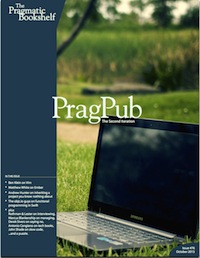
October PragPub Magazine
In the mid-1970s, building on the early ed line editor for Unix, Bill Joy and Chuck Haley wrote ex, which was distributed with the first BSD version of the operating system in 1978. Joy enhanced ex into the visual editor vi, still in use today, the default Unix editor included in every POSIX-compliant system, from Linux to Mac OS X. But vi was built on top of ex commands — as Joy has said, “fundamentally, vi is still ed inside”. So ex still survives and is equally ubiquitous. The most widely used vi clone today is vim, originally developed by Bram Moolenaar.
The fact that vim has a command-line editor inside it has some interesting implications, which Ben Klein explores in PragPub’s lead article this month, “Scripting Vim.” The compatibility of vim with ancient tools is remarkable, but more remarkable is what you can do with vim when you turn the compatibility off.
If you’re doing Web development, your idea of ancient might stretch back to 1995 and the creation of JavaScript. Surely the time before JavaScript was the prehistory of the Web. JavaScript is one of the fundamental technologies of the Web and the inspiration for countless tools whose entire purpose is to save you from JavaScript.
Ember is an open source JavaScript framework designed to waste less time reinventing the wheel. The Ember project was founded to put “all of the best ideas in web development into one framework, and to help developers waste less time on boilerplate code.” Matthew White introduces Ember in this issue, and explains why you may want to look into Ember if you want your Web app to compete with native apps in responsiveness and usability.
This issue also features another installment in our year-long series on functional programming in Swift by Chris Eidhof, Wouter Swierstra, and Florian Kugler.
But mastery of software development is about more than just writing code, and so is PragPub. Andrew Hunter shares insights on inheriting a project you know nothing about, Derek Sivers reveals that sometimes you have to say no to everything (else), Marcus Blankenship details what it means to be a software manager, and Johanna Rothman and Andy Lester talk about what to ask your candidates in an interview.
And of course Antonio Cangiano is back with all the new tech books, there’s a puzzle to exercise your mental muscles, and John Shade issues a manifesto.
Now available from theprosegarden.com.
Upcoming Author Appearances2015-10-07 Adam Tornhill,
GOTO Copenhagen, Denmark
2015-10-09 Janie Clayton,
CocoaLove 2015, Philadelphia, PN
2015-10-12 Adam Tornhill,
8th Light University (London, UK)
2015-10-13 Adam Tornhill,
Software Architect 2015, London, UK
2015-10-20 Mattias Skarin,
Lean Kanban Nordic - Stop Starting 2015, Stockholm
2015-10-25 Johanna Rothman,
Tel Aviv, Israel
2015-10-26 Adam Tornhill,
Trondheim Developer Conference, Norway
2015-10-26 Johanna Rothman,
Tel Aviv, Israel
2015-11-04 Adam Tornhill,
Øredev 2015, Malmö, Sweden
2015-11-05 Chris Adamson,
CocoaConf San Jose
Don't Get Left Out
Are your friends jealous that you get these spiffy email newsletters and they don't? Clue them in that all they need to do is create an account on pragprog.com (email address and password is all it takes) and select the checkbox to receive newsletters.
Are you following us on Twitter and/or Facebook? Here's where you can find us and keep up with the latest news and commentary, and occasional discounts:
Tell your friends! Tweet this
Follow us on Twitter: @pragprog, @pragpub, Andy @PragmaticAndy and Dave @pragdave.
Dave & Andy
The Pragmatic Programmers
Books • eBooks • PragPub Magazine • Audiobooks and Screencasts
PragProg.com
Manage your subscription using your account, or permanently unsubscribe here.
Sent by the Pragmatic Programmers, LLC. • 2831 El Dorado Pkwy, #103-381 • Frisco TX 75033
|