|
March 02, 2016
On this day in 1949, New Milford, Connecticut got the world's first automatic street light installed. On at dusk, off at daybreak. Pretty simple data requirements. Ah, the good old days. Now even lights can be WiFi enabled in an endless sea of data. In the iOS and Mac ecosystem, you need help: you need Core Data.
Core Data is intricate, powerful, and necessary, and our Core Data books are your guide to harnessing its power. Now available in beta in both the new Swift edition, and the updated Objective-C edition.
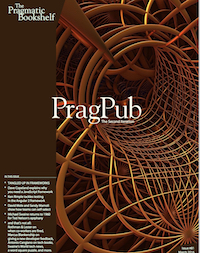
And of course, don't forget this month's PragPub magazine, chock full of goodness.
Read on...
Core Data in Swift: Data Storage and Management for iOS and OS X

Core Data expert Marcus Zarra walks you through a fully developed application based around the Core Data APIs. You'll build on this application throughout the book, learning key Core Data elements such as NSPredicate, NSFetchRequest, thread management, and memory management.
Start with the basics of Core Data and learn how to use it to develop your application. Then delve deep into the API details. Explore how to get Core Data integrated into your application properly, and work with this flexible API to create convenience methods to improve your application's maintainability. Reduce your migration difficulties, integrate your Core Data app with iCloud and Watch Kit, and use Core Data in a queue-based environment. By the end of the book, you'll have built a full-featured application, gained a complete understanding of Core Data, and learned how to integrate your application into the iPhone/iPad platform.
This book is based on Core Data in Objective-C, Third Edition. It focuses on Swift and adds an additional chapter on how to integrate Core Data with an efficient network implementation, with best practices on how to load and pre-load data into your Swift application.
Now available from pragprog.com/book/mzswift.
Core Data in Objective-C, Third Edition: Data Storage and Management for iOS and OS X

Core Data expert Marcus Zarra walks you through a fully developed application based around the Core Data APIs. You'll build on this application throughout the book, learning key Core Data principles such as NSPredicate, NSFetchRequest, thread management, and memory management.
Start with the basics of Core Data and learn how to use it to develop your application. Then delve deep into the API details. Explore how to get Core Data integrated into your application properly, and work with this flexible API to create convenience methods to improve your application's maintainability. Reduce your migration difficulties, integrate your Core Data app with iCloud and Watch Kit, and use Core Data in a queue-based environment. By the end of the book, you'll have built a full-featured application, gained a complete understanding of Core Data, and learned how to integrate your application into the iPhone/iPad platform.
This third edition updates all examples for OS X El Capitan and iOS 9, and gets you up to speed on changes in multithreading and batch processing. There's a new chapter on efficiently importing data from a network location, and a new discussion of how best to pre-load data into your application.
Now available from pragprog.com/book/mzcd3.
March PragPub Magazine

I don’t have to tell you about frameworks. Chances are you’re fully conversant with more than one web app framework. You may have tracked the evolution of frameworks from the earliest days. You’re off the Rails. You’ve gone Angular. I get it.
But new frameworks are appearing all the time. Nobody can be conversant with all of them. Nor need you be. To quote Jack Moffitt, coauthor of Seven Web Frameworks in Seven Weeks:
“There are countless ways to solve problems.... There’s no one way to build a web app, and no two projects of mine have ever been built the same way. Web programming is unique in having hundreds of available frameworks and libraries; traditional GUI programming tends to have very few choices.”
Having choices is good. Then there’s this from Jack’s coauthor, Fred Daoud:
“Programming in general and web development in particular evolves at a fantastic pace.” One change in frameworks is that you have more choice in how deeply you need to immerse yourself: “After suffering through bloated and overly complex so-called ‘enterprise’ frameworks, it felt refreshing to explore frameworks that let you get started with very little code and just ‘use what you need.’” Choice is good. And you can choose a client-side framework so that “JavaScript on the client is no longer a hodgepodge of code snippets.”
This month we have two articles focusing on frameworks, but from very different perspectives. Dave Copeland presents a compelling argument for why you need a JavaScript framework. Even if you’ve already reached that conclusion, you might want to read Dave’s article in case you need ammunition to argue that case someday.
Ken Rimple, on the other hand, takes a deep dive into Angular 2, the popular open-source web application framework maintained by Google and others. Specifically Angular 2 testing, which puts him out on the frontier of this new framework. He took a few arrows for you, and if you’re using or evaluating Angular, you’ll want to grab Ken’s insights and code.
Remember that great team you worked on that one time? Great people, a great project, you felt productive and happy. What if it were always like that? What if every team you worked on was a team you sought out because you wanted to work with those people on that project? That’s the inspiration behind self-organizing teams, an exciting idea explained by David Mole and Sandy Mamoli in their book Creating Great Teams. This month they explain the basics of the process.
Of course, sometimes things don’t work out so happily. The company is downsizing and has to lay some people off. One of your coworkers isn’t cutting it and is let go. How do you handle yourself at work when people are laid off or fired? What should or shouldn’t you say? What should you do? Johanna Rothman and Andy Lester discuss just that in their column this month.
And what if you’re the manager and a new employee hasn’t delivered the performance you expected? How do you offer course correction without demoralizing a new hire? How do you set expectations for the work and show respect for the individual? Marcus Blankenship tackles that situation in his New Manager’s Playbook this month.
And there’s more. Your editor continues his series on Ted Nelson and how he came to invent hypertext and Xanadu, the Web the Way It Should Have Been. This month it’s 1960 and Ted has the epiphany that will change his life.
Antonio Cangiano has all the latest tech books, we’ve put together a different sort of puzzle, tech news, and other goodies. I hope you like it.
Now available from theprosegarden.com.
Did You Know?
Please note our ebooks do not contain any Digital Restrictions Management, and have always been DRM-free. For us, "DRM Free" means "freedom": you should own the books you've paid for. On whatever device is handy—your laptop, iThingy, Blueberry, you name it. We think ideas should outlast any device you put them on.
And you can always come back and re-download your books when needed, using your account on pragprog.com. We're here to make your life easier.
Don't Get Left Out
Are your friends jealous that you get these spiffy email newsletters and they don't? Clue them in that all they need to do is create an account on pragprog.com (email address and password is all it takes) and select the checkbox to receive newsletters.
Are you following us on Twitter and/or Facebook? Here's where you can find us and keep up with the latest news and commentary, and occasional discounts:
Tell your friends! Tweet this
Follow us on Twitter: @pragprog, @pragpub, Andy @PragmaticAndy and Dave @pragdave.
Dave & Andy
The Pragmatic Programmers
Books • eBooks • PragPub Magazine • Audiobooks and Screencasts
PragProg.com
Manage your subscription using your account, or permanently unsubscribe here.
Sent by the Pragmatic Programmers, LLC. • 2831 El Dorado Pkwy, #103-381 • Frisco TX 75033
|