|
March 11, 2020
"Wireless telegraphy" has been with us since the late 1800s, moving from the experimental curiosity of Hertzian waves to primitive AM broadcast radio with crystal sets and glowing vacuum tubes.
With modern digital tech, you can use your laptop or a Raspberry Pi to experiment with receiving and decoding radio signals yourself, from satellites to shortwave to terrestrial sources.
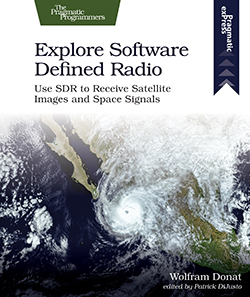
See what you've been missing and Explore Software Defined Radio: Use SDR to Receive Satellite Images and Space Signals, now available in beta from pragprog.com/book/wdradio.
Explore Software Defined Radio: Use SDR to Receive Satellite Images and Space Signals
Combine your desktop or laptop computer with easy-to-find, Software Defined Radio (SDR) equipment, and tune in a wide range of signals in no time at all. Go one step further by converting a Raspberry Pi into your own dedicated SDR device.
SDR USB dongles are usually designed to receive and decode high-definition digital television broadcasts, but the rising popularity of SDR has led to several of these devices being specifically made for—and marketed to—the software radio crowd. With step-by-step instructions, you'll have no problem getting everything up and running on both Windows and Linux.
The antenna is the final piece in the SDR puzzle: Which antenna do you use? What shape do you need? How big does it have to be? And where do you point it? Get all the answers you need and learn what's possible when it comes to picking out or building an antenna. And if you're not particularly handy, don't worry. You can use an old-school set of rabbit ear antennas without too much modification.
Discover the fun of this growing hobby and then open your ears to the hidden signals that surround you.
Now available in beta from pragprog.com/book/wdradio.
Upcoming Author Appearances2020-03-12 Jon Reid,
Advanced TDD with Swift, Linz, Austria
2020-03-13 Craig Walls,
New England Software Symposium (NFJS)
2020-03-16 Jon Reid,
TDD for iOS Workshop, Amsterdam, Netherlands
2020-03-24 Venkat Subramaniam,
dev.next, Broomfield, Colorado
2020-03-24 Diana Larsen,
Broomfield, Colorado USA
2020-03-24 Diana Larsen,
Broomfield, Colorado, USA
2020-03-25 Ethan Garofolo,
dev.next, Broomfield, Colorado
2020-04-01 George Dinwiddie,
TriAgile 2020, Raleigh NC
2020-04-03 Craig Walls,
Gateway Software Symposium
2020-04-07 Diana Larsen,
Portland, OR USA
2020-04-08 Adam Tornhill,
Heisenbug, St, Petersburg, Russia
2020-04-12 Frances Buontempo,
Fusion meetup, Birmingham, UK
2020-04-17 Craig Walls,
Northern Virginia Software Symposium (NFJS)
2020-04-21 Fred Hebert,
Web à Québec
You Could Be a Published Author
Is there a tech topic you are deeply passionate about and want to share with the rest of us? You could become a published Pragmatic Bookshelf author! Take a look at our pragprog.com/write-for-us page for details, including our 50% royalty (yes, for real!) and world-class development editors.
Don't Get Left Out
Are your friends jealous that you get these spiffy email newsletters and they don't? Clue them in that all they need to do is create an account on pragprog.com (email address and password is all it takes) and select the checkbox to receive newsletters.
Are you following us on Twitter and/or Facebook? Here's where you can find us and keep up with the latest news and commentary, and occasional discounts:
Tell your friends! Tweet this
Follow us on Twitter: @pragprog, @pragpub, Andy Hunt @PragmaticAndy.
Thanks for your continued support,
Andy Hunt
Publisher, Pragmatic Bookshelf
Books • eBooks • PragPub Magazine • Audiobooks and Screencasts
PragProg.com
Manage your subscription using your account, or permanently unsubscribe here.
Sent by the Pragmatic Programmers, LLC. • 9650 Strickland Rd Ste 103-255• Raleigh NC 27615
|